Saturday, July 9, 2011

Class this week!


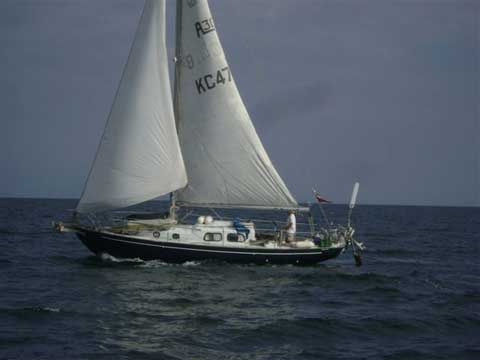
I get my first taste of some sailing this week, and I'm pretty excited!  3 hours of an classrom class, then an afternoon on a local lake.  Of course the problem could be that once I get a taste of sailing I have to shorten the timeframe of the plan dramatically; a risk I'm more then willing to take :)

I know it's just a few hours but it's a start.  Then maybe move onto a sailing club on one of the small lakes nearby.  I have a very nice offer from a couple in Annapolis I talked to via the Sailnet forums to go out with them (I think they just want to make me miserable about not having a boat! - so mean ).  The sailing community is so friendly to everybody; it's very refreshing!

After that - who knows where I'll end up!  Somewhere warm I'm hoping!

Thursday, July 7, 2011

See what you are missing

Today I thought I'd provide a public service for all of you liveaboard cruisers.  This thought came to me today as I was coming back from a soccer practice with my daughter.  We had to get on the highway for a little bit, and thus the inspiration.    


You are very welcome for this little remembrance of life on land :)  Every day just gives me even more inspiration to shorten my timetable and head out.

So good sailing to all of you out there - I'll find you eventually!

Wednesday, July 6, 2011

Electric Propulsion?

Part of the allure of a sailboat, is the freedom of the wind (well, when there is wind). The low impact on the environment, and enjoying nature without an engine running in the background.   Well in my many travels through the internet (it really is a big place), I've come across a couple references to green sailing, and electric propulsion.  It sounds too good to be true - and probably is.  The engine when running is quiet, but for long cruising you can't really recover enough power without a genset.   But maybe battery technology will improve - I mean seriously, at the rate I'm progressing on my journey we'll probably have transporters before I sail! So below are comments from one of the companies that produces the engines.  Just something to think about.


Just push the throttle and go.

No more grinding the starter,
Or praying the engine will catch,
Or waiting for it to warm up,
Or clunking the gears into forward,
Or ear-shattering noise,
Or obnoxious fumes.

You slide away from the pier in silence - as quietly as under sail. The only sound is water slapping the hull. The only smell is the salt sea air.

It's clean, green, electric sailing. And with oil near $100 a barrel, and environmental regulations increasing, it's the sailing wave of the future.


Energy from batteries:
Batteries deep in the hull provide the energy to move. They've been charged from dockside AC or from onboard solar panels.           

Electrons flow from the batteries through a controller that chops them into pulses. The pulses surge through the motor windings and create fluctuating magnetic fields that silently spin the shaft.      

If headwinds or high seas start to slow the boat down, more electrons automatically flow through the motor. Boat speed stays steady, without operator control.


Regeneration:
Regenerative sailing converts renewable energy from the wind to electricity that recharges the battery pack. A rough guide is that three hours of sailing regenerate the electricity from one hour of motoring. But the ratio varies greatly depending on sailing speed, prop size, rate of electrical consumption while motoring, etc.

When the sails go up in open water, you throttle the motor back so it's just ticking over. The motor turns the prop slowly while you sail. It corkscrews through the water and cancels most of the drag. When boat speed increases - from sliding down a wave or the wind picking up - the prop is forced to turn faster as the water rushes by. The motor then becomes a generator and sends electricity back to the batteries.

As you rise up the back of a wave, the ammeter reads negative. The motor is consuming more electricity to maintain speed on the upslope. Heading back down, the ammeter turns positive as the boat speeds up. The motor is regenerating electricity and recharging the batteries. On a windy day, the boat can return to the dock with more power than when it left.


If the wind dies, you push the throttle forward to maintain speed. Apparent wind picks up and keeps the sails pulling. Now you're motorsailing, but still with no noise or diesel smell, and you haven't burned a drop of fuel.
   

Generator backup:
Eventually the batteries discharge to their preset minimum level. A cocooned diesel generator starts up automatically. From the cockpit, it's barely audible over the wind through the rigging.

The generator runs with maximum efficiency at a constant, optimum speed. It recharges the batteries as the boat continues motoring, and shuts down automatically when they're fully charged.


Quiet nighttimes:
On the hook at night, the air conditioner starts up and runs quietly off the batteries. Depending on their state of charge, the batteries may power the AC through the entire night. If they run down, the cocooned generator automatically starts running quietly to bring them back up. No more getting up in the middle of the night to start a noisy diesel engine to recharge the house batteries.

Maximum control:
Heading back to the dock, the boat is easy to control. The motor can be slowed to single digit rpms, stopped and started repeatedly, and reversed in an instant.

No more wrestling the shift lever from forward to neutral to reverse to forward again. No more heading into a slip too fast with no way to go slower. Collisions with the dock are a thing of the past.


Its all part of clean, green, electric sailing - the sailing wave of the future.


It sounds good, but until the battery technology improves, I don't know if it will appeal to cruisers or not.  This all probably goes against the simpler is better statement that I've been told to follow, but it sure sounds like a neat idea!

Tuesday, July 5, 2011

Keels

 This is really just information for me, as I'm sure everybody else already knows it.  But it's my blog so I'm putting it in here anyways :)  As my dreaming/planning stage continues I need to figure out what I want out of a boat (which of course will change many times over this journey I'm sure).  So today I'm going over the different types of keels.  Grab some caffeine and try and stay awake please! This is just information I've pulled together from various blogs/forums/info on the net.


Full Keel

A full keel by definition runs the length of at least 50% of the hull.
The forward edge curves vertically while the aft edge often connects to
a rudder. The main advantage of a full keel are safe grounding and
directional stability.Safe grounding means a full keel is safer when you lie on hard ground.
Whether along the coastline or in travel lift slings, the full keel
provides a strong, stable balancing point for the hull. A full keel
boat will not tip on its bow or stern. When you ground then, the boat
will lay on her side in shoal water and take less damage. In a travel
lift, the full keel is easier to sling with the longer keel line.

Blocked up on the hard, the full keel provides a line of balance. Be it
an unintentional or intentional grounding, a full keel has more stability.
A full keeled boat points well when in the water. It has good
directional stability. Put the boat in a compass direction and with a
properly designed full keel is likely to stay pointing in that compass
direction. The full keel has longer waterline length so controls the
flowing water more than shorter keels. The water rushes by for a longer
distance and smoother flow. Turbulence is less likely to generate
forces to twist the boat. The full keeled boat is less likely than a
fin to fall off because this smoother flow. The boat has greater
directional stability than a fin.


Pros: A lot more headroom in the cabin because there is no trunk, ususally very good
ultimate stability (the ability to right itself, even from full turtle). 


Cons: When you run aground, you can't just raise the keel to free yourself,
you have to employ interesting tactics like getting a crewman to hang
on the boom, and then swing out over the side.


Fin Keel

By the classic definition of a fin keel any keel whose bottom is less
than 50% of the length of the boat is a fin keel. Fin keels came into
being in an effort to reduce drag. Cut away the forefoot or rake the     
stem, as well as, move the rudderpost forward and rake it sharply and
pretty soon you have a fin keel. Today we assume that fin keels mean a
separated rudder (skeg hung or spade) but in fact early fin keels had
the rudder attached in a worst of all worlds situation. They offer all
of the disadvantages of both full and fin keels, but with none of the
virtues. Unknowing or unscrupulous brokers will often refer to boats
with fin (or near fin) keels as full keel if they have an attached
rudder.


Pros:  They have less drag as explained above so they typically make less 
leeway and go faster. You can get the ballast down lower so in theory 
they are more stable for their weight. They are more maneuverable. 
They take better advantage of the high efficiency of modern sail plans and materials.

Cons:   They have less directional stability than long keel
boats so the tend to wander more under sail.Fin keels are harder to

engineer to withstand a hard grounding and when aground they 
are more likely to flop over on their bow or stern. Fins typically have 
deeper draft. They are easier to pivot around and get off in a simple grounding.

Bulb

The bulb is a shoal draft fin keel. Basically, you saw off a deep fin
keel and attach a torpedo shaped bulb of lead to the keel bottom. This
shallower keel is a compromise between the performance of a fin but the
realities of cruising in the Bahamas, Cheasapeake Bay, and other shoal    
water holes. Often makers these days produce shoal and deep versions of
their designs. Hylas, Valiant, and Tayana come to mind. If you plan to
sail in shoal waters, they recommend a bulb keel but otherwise you will
enjoy the deep fin keel. As a side benefit if you do ground on a soft 

bottom and sink in, the bulb keel is the easiest to free. The bulb does
not stick way down into or catch the muck like other designs. The bulb
at the bottom plops out easily.


Wing Keel


Wing keels are a specialized type of bulb keel. Instead of a torpedo
shaped bulb there are small lead wings more or less perpendicular to
the keel. These concentrate weight lower like a bulb and properly             
designed they also are very efficient in reducing tip vortex. There has
been some discussion that wings increase the effective span of the keel
when heeled over but this does not seem to be born out in tank testing
of the short wings currently being used in production sailboats. Not
all wings are created equal. They potentially offer a lot of
advantages, but they are heavily dependent on the quality of the design
and I really think that many wing designs are not really working to
their potential.


Pros:  The wing has better performance than the bulb because
she reduces tip vortex turbulence. The draft can be even less. Because
the two bulbs are offset they do not mess with the leading keel edge
and generate turbulence like a simple bulb keel. 


Cons: As a drawback, the wing is the most difficult to free if you slide
into muck. The wings have a way of gripping down into the bottom. In 
2002, the Naval Academy did  a study of keel types and grounding. They
found that the popular perception that wing keels are harder to free is accurate. In their
study, wing keels were extremely harder to free. Straight fins were
much easier to free, especially when heeled, and the easiest keel to
free was the bulb keel.


Centerboards

Centerboards are appendages that can be raised and lowered on or near
the centerline of the boat. They can rotate up into a trunk or rotate
below the boat. Daggerboards are a type of centerboard that raises   
vertically or near vertically in a trunk. Swing keels are a type of
rotating centerboard that actually contains a substantial portion of
the boat’s ballast. They may be housed in a trunk like a Tartan 27 or
34 or hung below the boat like a Catalina 22. In the case of the Tartan
27 or 34 they are more frequently referred to as a Keel/ Centerboard
(abbreviated k/cb). A swing keel is intended to act as a fin keel when
lowered and allow some sailing in the partially raised position.


Pros: The centerboard keel has a base keel with a dagger than 
rotates downward. When the water is deep, you stick the centerboard down.
When shoal, you sail centerboard up. You get the performance of a deep
keel and the manuverability of the shoal – a perfect idea, right? 

Cons: The drawback is maintenance with the centerboard. As with any 
moving part, problems arise. The centerboard has to be maintained.


Ok - it's time to wake up now. Obviously there are other types of keels out there, and variations of the above.  But if I went through it all, you really would be asleep.  This seemed like a decent set of the more common keels to me (I know - I'm a novice, so don't take it as the end all be all of keel knowledge).  Rest assured that none of the information is mine.  It's all pulled from people much more knowledgeable then me.  My thoughts on keels for me is that I want something that doesn't have moveable parts - simpler is better I've been told.  I like the idea of the stability of the full keel, but am worried that the draft may be too much for where I potentially want to travel.    Of course if budget was no concern I'd like a catamaran.  I of course say that without comparing cat's versus monohulls in person.  So that may change once I get on board some boats.

If you've made it all the way down to here congratulations - you've earned yourself a drink!

Good sailing to you and yours!

Monday, July 4, 2011

Happy Fourth of July


My apologies to all of you that aren't from the USA.  But

  HAPPY FOURTH OF JULY !!!!!!

Sunday, July 3, 2011

Window Shoping

So what does somebody that wants to liveaboard, but doesn't have a boat yet do - why they go out and look at boats for sail on the internet and dream of course!   So here are some of the boats I picked out as I was looking.  Obviously I'll be having to do work on whatever boat I get due to my anticipated budget.   But I'm trying to keep it simple per the recommendations of some of you fine folks.  


Grampian 34                           

Elysian is a rare 1973 Grampian 34 center-cockpit ketch. Solid comfortable cruising boat with lots of storage, easy handling, full aft cabin. Many recent upgrades, too many to list but include new electrical systems, sails, 2-anchor bow roller, and all-new LED lighting (cabin and tri-light). All new SS opening ports. New epoxy barrier coat. Thunder Bay, ON. $22,000 CND. http://elysian.ca

Price: $22,000 CND


Pearson 323, 1978  

In very good condition.

# It has a rebuilt atomic 4 engine with electronic ignition and fresh water cooling,
# newer full batten main in very good condition,
# roller furling headsail in fair condition.

# It has no soft spots and deck gelcoat is in very good condition for her age, no chips or cracking.
# It has wheel steering and auto pilot.
# This is an easy boat to single handed or cruise with a family.
# Comes with spinnaker sock.
# I sail this boat regularly so its ready to go.           At $15000 it's a bargain and won't last. 


Pearson 27, 1988  

Great Sailboat,          
# 12 horse Universal diesel,    
# Pedestal Steering with compass,
# knot and depth meter,
# Quantum sails and spinnaker,
# Jib furling,
# Double battery setup with charger,
# Bimini,
# cockpit cushions,
# Beautiful spacious interior with two cabins,
# Head with holding tank,
# Galley with stove,
# ice box, and sink.


Alberg 30, 1971     

Be sailing the Caribbean next week in this classic blue water boat for less than $10,000.

Length 30', Beam 8'9", Draft 4'6"

Engine: Westerbeke M320B Diesel, 18HP meticulously maintained

Navigation: Autopilot WP5000 and Windvane steering by Neptune

# Electronics: two GPS units, SSB Receiver, VHF Icom and handheld unit, depthsounder,
# Tanks: Fuel: 18 gallons, Water: 30 gallons
# Anchors: 33 lbs Bruce, 25 lbs Mansow, Fortress FX16, two Danforths
# Sails in good condition: mainsail, jib, genoa

# Electrical: two batteries, 55 amp alternator, two inverters, 30 amp battery charger
# Galley: 1 propane burner, sink, 110V fridge with freezer, large ice box
# Marine head with privacy
# Cockpit awning, dodger, swim ladder
# Cruise at 5.5K using 1/2 gallon of fuel

Inflatable dinghy with 3.3HP outboard


27' Catalina C27    

Year    1982
   
Length  27
   
Beam   8'10"
   
Draft    4'
   
Location  New York
   
Price         $9,500

Description:     Accomodations: Bunks for 2 in forward Vee berths, 1 in main cabin settee on Stb, 1 on port settee, 1 in stb Quarterberth. Note the main cabin stb settee could be modified to be a pull out double, head is manual flush with holding tank deck pump-out and thru hull macerator. table is bulkhead mounted and may be used in lowered position 1/2 open or fully open. Galley: galley has ice box, propane 2 burner stove, manual water system. Navigation/Electronics: compass, depth sounder, Loran, VHF, speed. Electrical: 2 batteries battery parallel switch. Mechanical: tiller steering, 1 fire extinguisher, cockpit controls. NEW shaft and cutlass bearing, NEW exhaust. Deck: Bow pulpit, lifelines with stern rails, fenders and lines, nav. lights, SS stern mounted swim ladder, spreader lights, 4 life jackets, Coast Guard safety package, including throwing device, anchor shackles chain rode horn and flares. Sails and Rigging: Main, Jib, Cruise equipped, manual backstay adjuster, roller furling on jib, 6 winches.


We will see after I've gotten some real sailing under my belt, and have read up some more, what types of choices I'll make as far as boats.   I'd really like a catamaran, but I don't think my budget is going to allow that. 

 Hope you all are enjoying your weekend!

Friday, July 1, 2011

And it starts - class and books

So I've officially registered for a little 2-day class here in the Cincinnati area (wait - there's sailing available near Cincinnati - crazy!).  1st day is in the class room, and the 2nd day is on the water.   That's in a couple weeks, so either my desire will be strengthened, or there will be some embarrassing post later on here about  how sailing isn't for me (maybe just a nice houseboat somewhere ;) ).  I doubt it but stranger things have happened I'm sure. So I decided to pick up a couple books as well to really stir the excitement a bit.


Yep - it's true, the man has no shame - Sailing For Dummies. At least overconfidence won't be a problem.  The other book, Sailing the Dream, just looked interesting.  We'll see how the reading goes. I imagine my easily-impressionable mind will be fascinated by the tales of a couple selling everything and going sailing.  Sounds like the path I may be on.  Well, except for the 2 people together thing - I really do need to get that Sugar-Momma search going full strength!

Well that's it for today.  Everybody out there enjoying their 4th of July weekend, or Canada Day weekend (I think that's right - ignorant American I am), or just out there enjoying sailing - have a safe and glorious weekend!

 I'll leave you with a quote near the beginning of the Sailing for Dummies book that I like.

It is an interesting biological fact that all of us have, in our veins, the exact same percentage of salt in our blood that exists in the ocean, and therefore, we have salt in our blood, in our sweat, in our tears.  We are tied to the ocean. And when we go back to the sea, whether it is to sail or to watch it - we are going back from whence we came.
                                                                             - John F. Kennedy